
It is unusual for infected tissue to produce new viruses. However, the viruses can remain inactive after infecting tissue and then later become active following injury or irritation of the tissue.
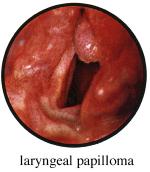
Papillomas tend to occur most often along certain regions of the upper airway. These areas include the vocal folds themselves, the lower portion of the larynx, the nasopharynx and just inside the nose. At these regions the lining of the airway changes from one tissue type to another, and it is thought that this transition increases the likelihood of papilloma growth. It changes from the squamous type of epithelium that lines our cheeks to a ciliated respiratory epithelium that lines the lower windpipe.
The trachea (windpipe) and the bronchi within the lung can also become infected. These infections are much more serious and difficult to take care of because airway obstruction can occur more rapidly. Fortunately, only 2-3% of patients with laryngeal papillomas will develop bronchial lesions.
RRPs are usually divided into a juvenile-onset and an adult-onset form. The juvenile form tends to be more aggressive and requires frequent removal. It occurs at a young age, often appearing before age 5. About one-half of the children with laryngeal papillomas are born to mothers with genital HPV infections. It is believed that the child may become infected while passing through the birth canal since the infection rate is much lower in cesarean sections. The cause for the infection in the other children is not known. However, the risk of papilloma infection for a child born to a mother with an HPV infection is only 1 in 400, so elective cesarean delivery is not appropriate just to try to prevent infection.
The most common symptom of RRPs is hoarseness. For lesions that form near the vocal folds, hoarseness can occur very quickly with small lesions. As the disease progresses, shortness of breath can occur as the airway becomes blocked.
Papillomas can be easily diagnosed with a careful examination of the larynx. In order to confirm the diagnosis and to rule out other diseases, a biopsy of the papilloma is necessary. For papillomas in the larynx itself it is generally done in the operating room.
In adults, papillomas occur in the same locations but the tend to be less extensive. There is some evidence that these papillomas may have a slightly higher risk of transformation to cancer, although this has not been adequately proven. The source of adult infections is also not known. It may represent new infection or it may be reactivation of latent virus already in the tissue.